A Practical Workflow for Keeping and Verifying Deep Research Sources
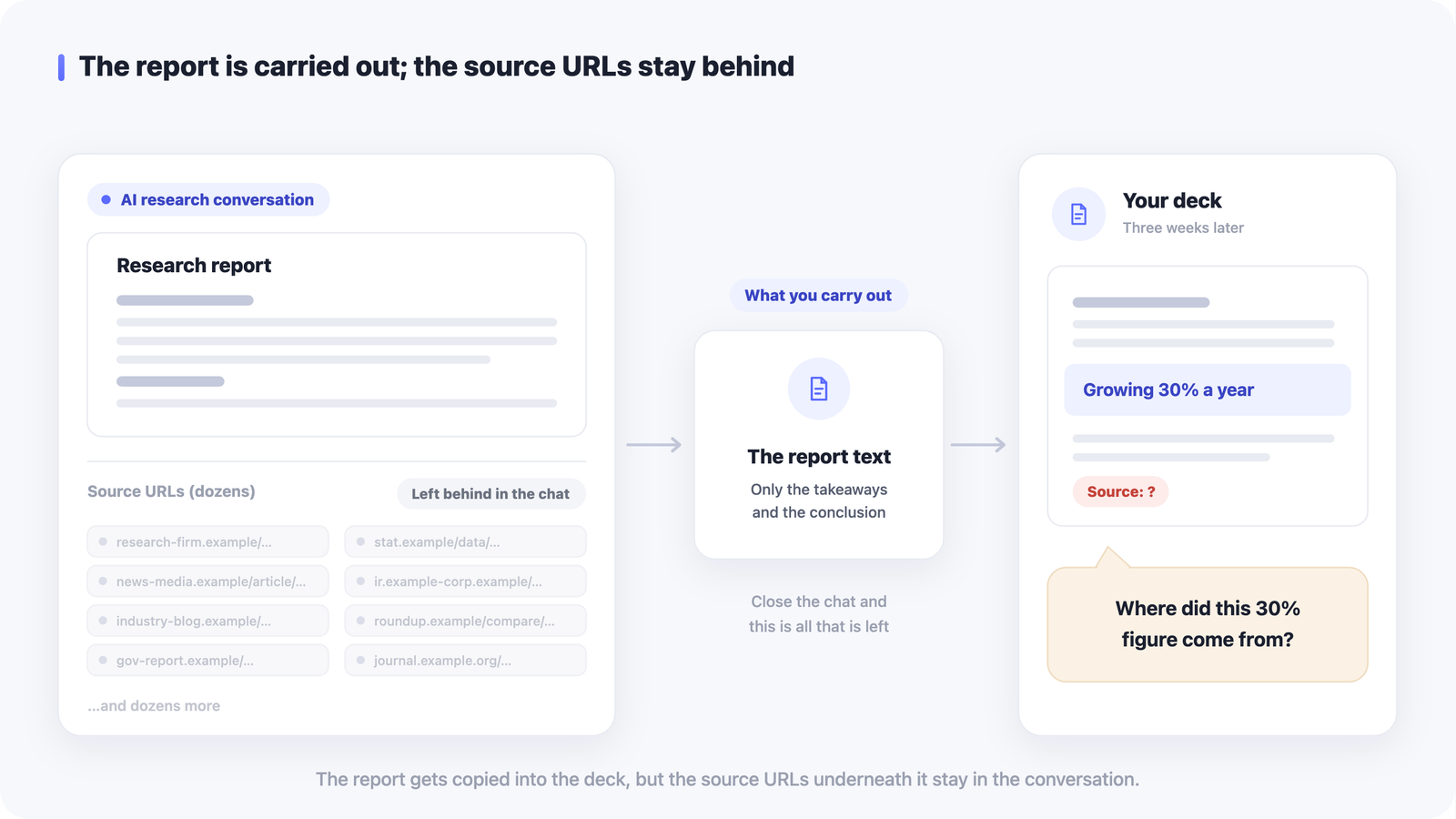
You ask a deep research tool to size a market, and fifteen minutes later a neatly structured report comes back. You read it, and the argument holds. You copy the key points into your deck and close the conversation. Three weeks later, in a meeting, someone asks where that 30% figure came from — and that is the moment your hand stops. The source URLs were there, listed underneath the report. But they lived inside the conversation, and the moment you closed it they were effectively gone from your desk. Getting them back starts with remembering which chat, on which day, with which prompt. This article takes a clear position. What AI research features shortened is the work of gathering information, and only that. Deciding whether the information can be trusted is still a human job. And to do that job at all, the source URLs have to survive outside the conversation. What follows is the whole workflow: why sources get discarded for structural reasons, how to narrow down what to check instead of reading everything, how to sort what you checked, what to do in the ten minutes right after a run, and how to make the same thing work across a team.
Why source URLs get thrown away with the conversation
It isn't that nobody means to keep them. It's that three conditions stack up, and together they make discarding the default.
They are buried inside a conversation. The source URLs sit on that chat screen as part of the report. Right after the run they are in front of you, but the second you move on to the next task they become "an old conversation." Unlike a browser tab or a bookmark, they never appear in a place you open as a matter of routine.
There are too many of them to face. A single run routinely lists dozens of sources. You don't have time to open them all — and you have no rule for opening only some. So none of them get opened. The real trap in this step is that it collapses into a binary: read every one, or read none.
The report looks finished. This is the worst of the three. When a document arrives with headings, a comparison of options, and footnotes, it reads as a deliverable rather than a draft. People don't fact-check deliverables. A handwritten note makes you think "I should confirm this"; a well-formatted report quietly switches that instinct off.
None of the three is a failure of attention. Checking sources isn't built into the procedure, so it stays a judgment call made in the moment — and in the moment, the answer is almost always "later."
What AI shortened is the gathering, and only the gathering
Break research into parts and you get two phases.
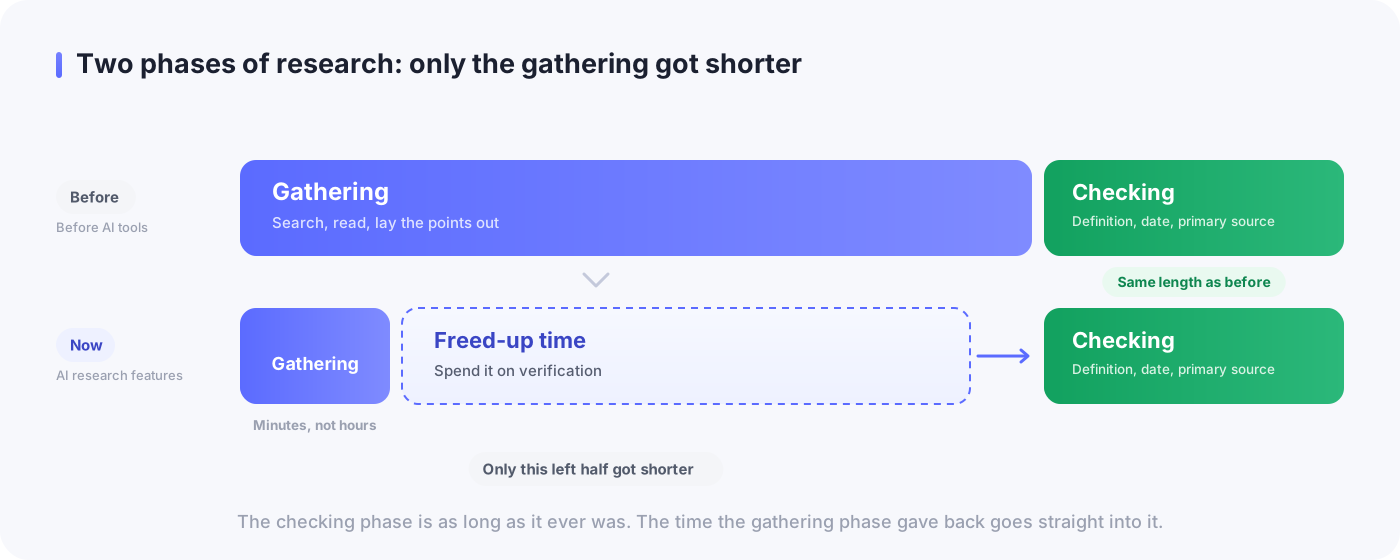
The first is gathering. You think of search terms, open results, pick out the pages that look relevant, pull the important bits and lay them side by side. This is the part AI research features have compressed dramatically. As of September 2026, ChatGPT's deep research spends anywhere from a few minutes to tens of minutes reading a large number of pages and returns a structured report with sources attached. Gemini, Perplexity and Claude all offer something comparable, and each of them takes you as far as "a report that shows its sources."
The second is deciding whether to believe it. Who produced that number, when, and under what definition? Was the population studied the same as your market? Is the citation a primary source or somebody's summary of one? This phase has not gotten shorter, and the reason is that the judgment depends on what you intend to do with the answer. The same statistic needs one level of confidence when it seeds an internal discussion and quite another when it goes into a proposal a client will read. The purpose belongs to the human side of the desk.
The other thing worth holding on to is that a source being shown and a source backing up the claim are two different things. A sentence with a citation attached can turn out to say something slightly different from the page it cites. A drift like that is invisible if you only ever look at the report. You find it by opening the original page and putting its numbers next to the ones in front of you.
So the division of labour — AI gathers, people verify — has exactly one precondition: the source URLs have to exist outside the conversation, in a form you can open later. Meet that one condition and the time the gathering phase gave back is yours to spend on verification.
Don't read them all: three tests for picking what to check
This is the practical heart of the article. Working through dozens of sources is not realistic, and attempting it is what produces zero. Deciding what qualifies for a check before you start is the only approach that survives contact with a real week.
Test 1: The number the conclusion turns on
The claims to chase all the way back to a primary source are the ones that would change your conclusion if they were wrong.
Every report mixes numbers that carry the argument with numbers that set the mood. If it says "the market is growing 30% a year, so we should enter," then 30% is load-bearing. Something like "there are roughly five major players" is not: the recommendation reads the same whether the real answer is four or six.
The test is simple — delete the number and see whether the conclusion still stands. If it doesn't, that source gets opened. In a single report, usually three to five claims meet that bar. Out of dozens of sources, the ones you actually need to open are often just those few.
Test 2: The source that is somebody else's summary
The next thing to look for is a citation pointing at a roundup rather than an origin.
When a news article, an industry blog or a comparison site shows up as the source, the number in it almost always came from somewhere else: a research firm's report, a government statistic, a company's investor materials. In the act of quoting that original, a summary article tends to trim the period covered, round the units, or drop a footnote. None of that is malice — it's what you do to make a piece readable. But the footnote that got dropped is sometimes exactly the thing that determines whether the figure fits your use.
So: open the summary and follow it back to what it is quoting. One step is enough. If you can confirm the name of the publisher and the year of publication, the quality of your citation goes up sharply. A useful rule is that a roundup whose origin you cannot reach does not go into your deck as a source at all.
Test 3: Stale statistics and pages that no longer open
The third is a check on date and survival. This one takes seconds per link, so do it mechanically across everything rather than narrowing first.
There are two things to look at. One is when the work was done — not the value of the statistic but the date of the study. Whether the survey ran before or after a rule or a market shifted changes what the same number means. The other is whether the page is still alive: anything that 404s or redirects somewhere unrelated can't be cited as it stands.
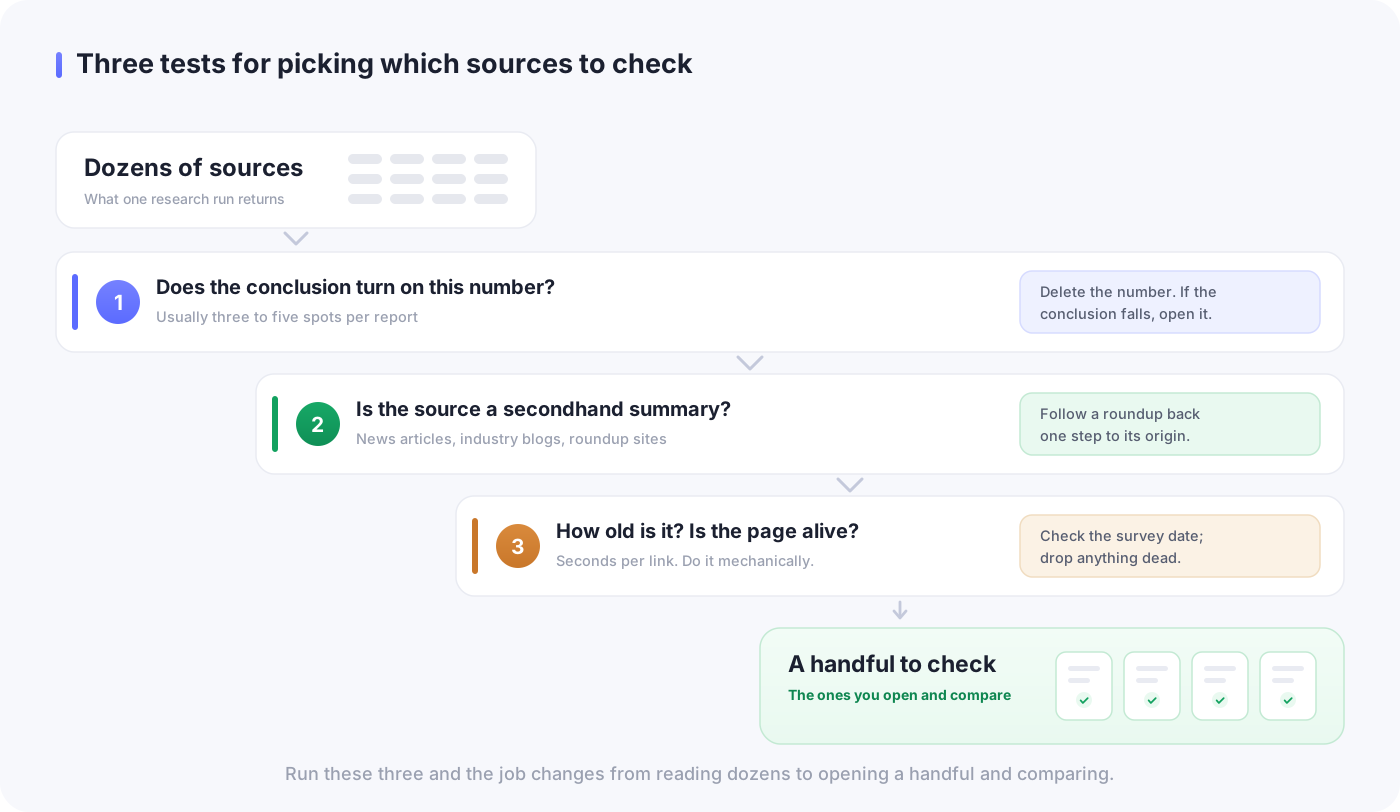
Run all three and the job changes shape: it stops being "read dozens of pages" and becomes "open a handful and compare them against the report." Once you have the habit, that takes twenty to thirty minutes. This is precisely where the time the gathering phase gave back is supposed to go.
Sort the source URLs into three piles
Everything that came through the tests gets sorted into three piles. The point of sorting is that you never have to think about it again when you're building the deck.
Use as is. A primary source, with the publisher and the date of the study stated, whose actual content matches what the report said about it. Write the URL and the date you checked it into your sources list, and you're done.
Check it yourself first. A primary source where you haven't yet worked out whether the definition of the number or the scope of the study matches your use. Or a source reached through a summary, where you found the origin but haven't read it properly. The right move for this layer is to keep it saved, in a holding state. If you get to it before the deadline, good; if you don't, the claim comes out of the deck.
Drop it. Pages that turned out not to support the claim, pages with no identifiable publisher or date, pages that are simply about a different question than the one you're working on. Making that call explicitly now means you won't reopen the same page next time you research the same topic.
Of the three, the one with the most practical value is the middle one. Without a place to park things, sources you couldn't finish checking drift toward one of the two extremes: they either get used anyway or disappear. Parking a source is only half the move, though: what turns a saved URL into something you can put in front of a client is a separate step, and three steps to turn saved AI information into something useful walks through it. The report itself belongs in your main workspace; the source URLs belong somewhere you can still act on them one at a time.
The ten minutes right after the research finishes
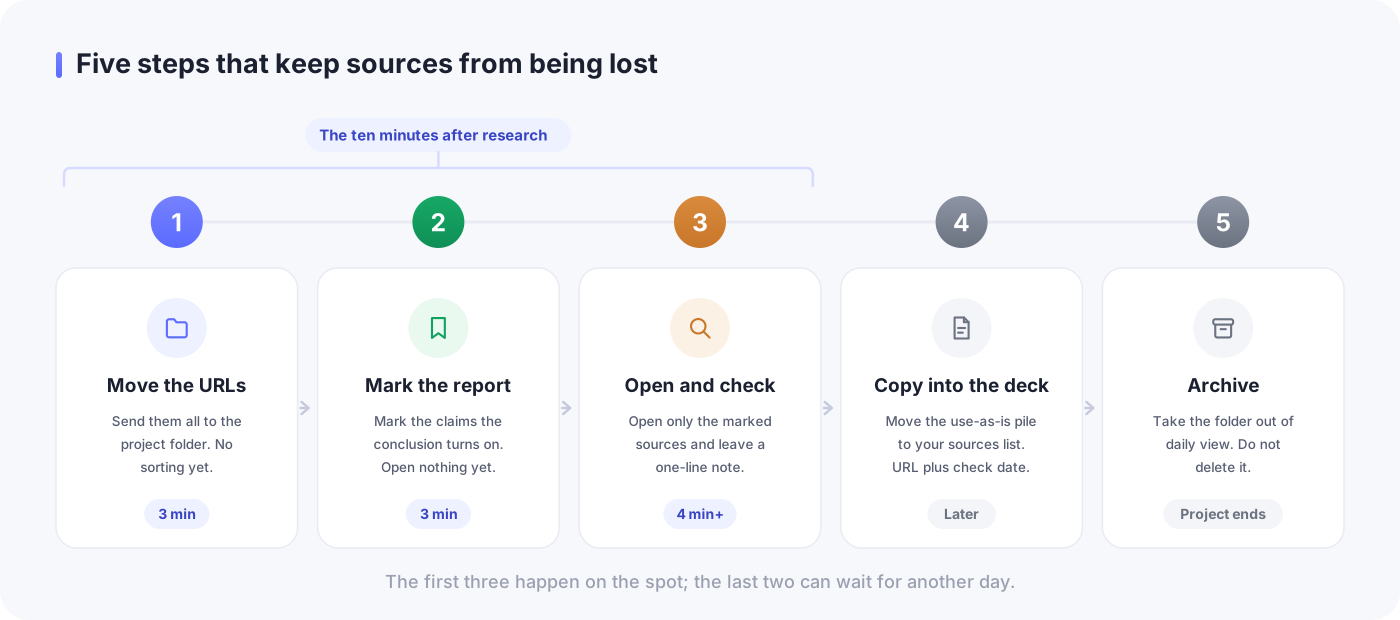
To make this run as a system rather than as good intentions, fix it to the clock. When the research finishes, spend ten minutes on it right there.
1. Move the source URLs into the project folder (3 minutes)
Before you read the report closely, move all of the source URLs into the folder for that project. Do not filter here. Filtering comes after moving. Do it the other way around and the moment your attention breaks mid-filter, the remainder stays behind in the conversation.
Ideally the folder exists before the research starts. Getting conclusions and links out of a chat instead of letting them stack up inside it is the same habit covered in why you can't find anything in your ChatGPT history: a conversation list is ordered by time and nothing else, so anything you want back later has to leave it first. Deep research sources are simply the highest-volume version of that problem.
2. Mark up the report (3 minutes)
Next, read back through the report and mark the claims that meet Test 1 — the ones where the conclusion turns on the number. Don't open any sources yet. Just mark. You should land on three to five.
3. Open only the marked sources and leave a one-line note (4 minutes plus)
Now open the sources behind the claims you marked. What you leave behind is one line recording what the check found. "Verified, FY2024 study." "Definition differs from our segment — careful." "Couldn't reach the original." That one line is what you'll make decisions on when you build the deck, and it doubles as the search term that finds this source again later.
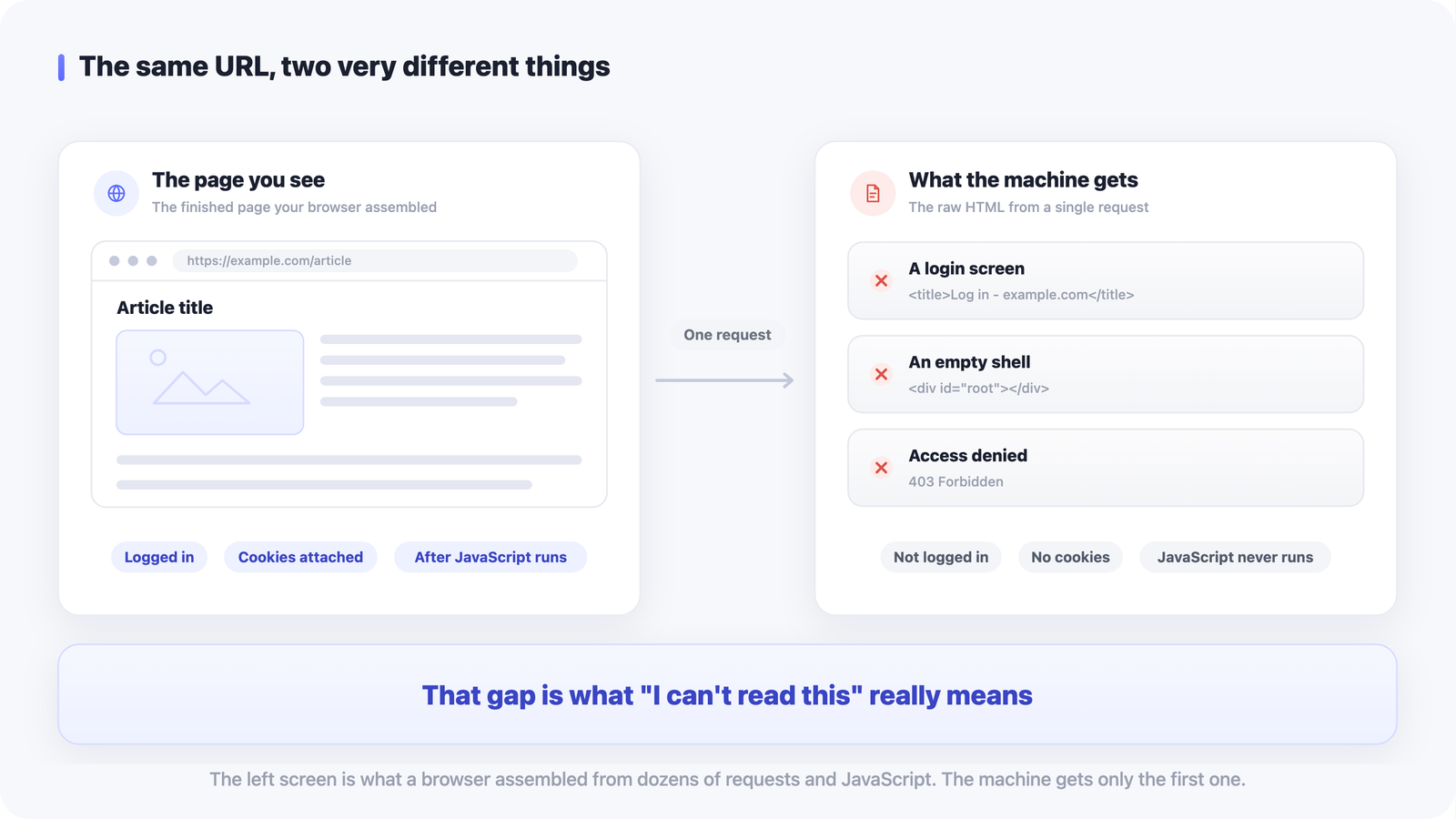
Some sources won't open at all — a login wall, a paywall, a page that only renders with JavaScript, a host that blocks automated readers. Handing the URL to an AI instead runs into the same walls, and seven reasons ChatGPT can't read a URL covers how to tell one cause from another. For this step, anything you can't open is just a source recorded as unverified. The line to write is never "why I saved this" — it's "what I found when I checked."
4. Copy into the deck (later)
When you build the deck, move the "use as is" pile into your sources list. Always write the URL and the date you checked it. Web pages get rewritten, and without that date there is no way to verify anything after the fact. Whether you can answer "where did this number come from" on the spot is decided right here.
5. Archive when the project ends
Once the work has been delivered, take the project folder out of the places you look every day. Don't delete it. The odds are good that you'll research the same topic again, and when you do, a record of which sources you verified and which you dropped means the second run can start from verification instead of from search.
On a team, record who checked what
When several people work from the same research, there is exactly one thing to add: make it visible who checked a source, and when.
There are two reasons. The first is avoiding duplicate work. Verification is the expensive phase, so two people opening the same primary source is pure loss. The second reason matters more: unchecked sources need to be identifiably unchecked. A source nobody has marked quietly becomes "somebody probably looked at it," and then it goes into the deck. That is where nearly every accident happens.
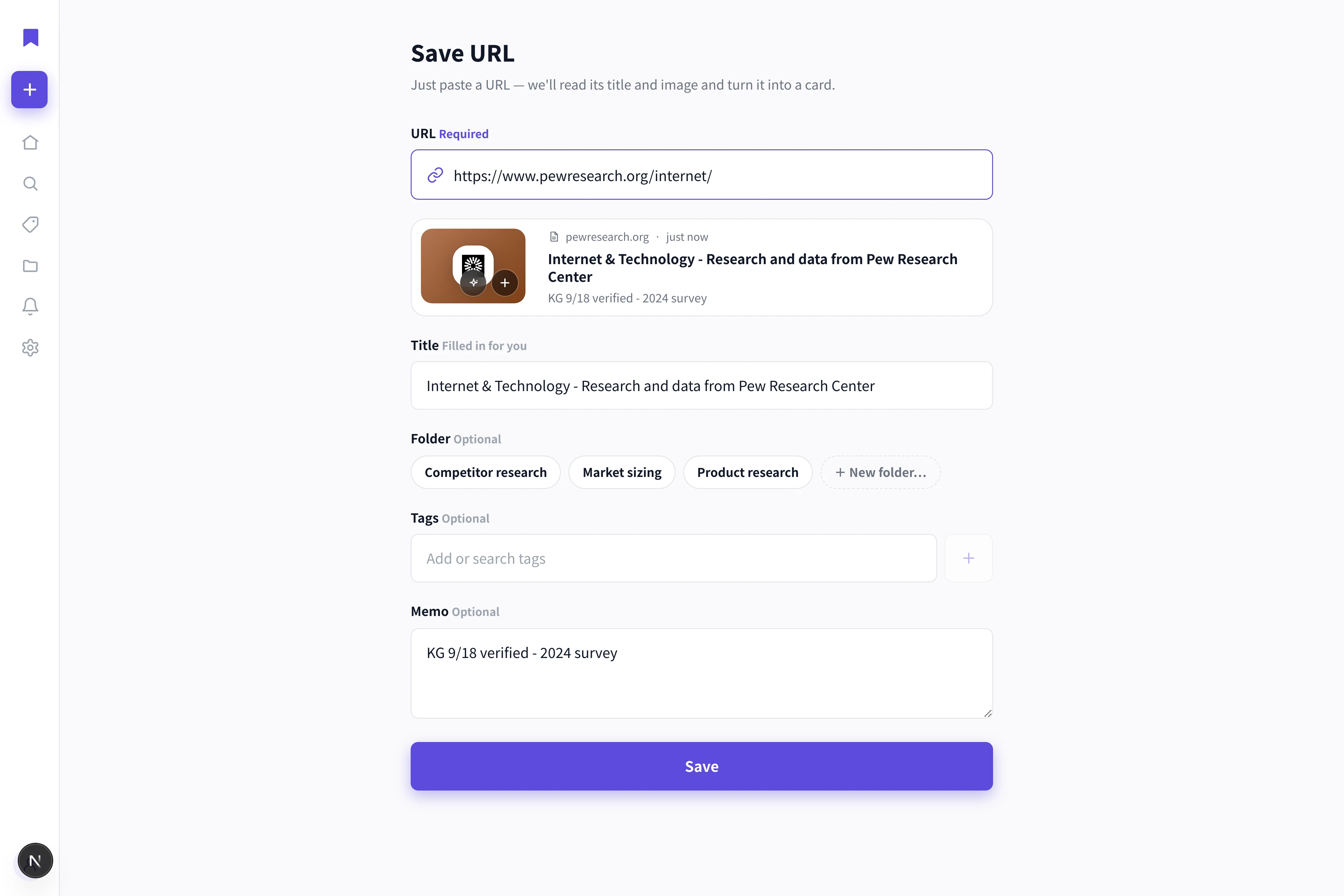
Keep the mechanism light. Put the checker's initials and the date at the front of the note — that's enough. "KG 9/18 verified." "Not yet checked." Agree on it as a team convention rather than reaching for a tool feature.
One more thing worth agreeing on: don't hand someone raw AI research output. What you hand over is not the report; it's the marked-up, sorted sources plus the one-line result of each check. From the receiving end, "these three are backed up, these two aren't checked yet" is far more useful than a beautifully formatted report.
The same structure carries a handover. If there is one project folder and every URL carries the result of its check, almost nothing needs to be explained out loud.
Four things to ask of the place you keep sources
The tool that supports all of the above needs four properties.
- It lives outside the conversation. You can keep sources somewhere independent of the AI service. The moment this depends on chat history, the workflow stops working.
- Saving is fast. Dozens of URLs go in within a few minutes. A place that takes effort per link is a place nobody uses on a busy day.
- Notes can be added afterwards. You can write a line at the moment you finish checking, not only at the moment you save. For managing sources, that after-the-fact line is the whole point.
- It bundles by project and searches across them. Active projects stay separated, and sources from past projects remain findable.
LaterList, for example, pulls the title, thumbnail and description automatically when you paste a URL, and lets you attach a note. Folders separate one project from the next, and a folder can be shared with your team. Search runs across everything, so a note that says "verified" is enough to pull a source back up months later. Read state is tracked, so you can tell at a glance which sources in a list you've already been through.
For what it's worth, as of September 2026 ChatGPT's deep research is limited on the free and Go plans, and comes as 25 runs a month on Plus, Business and Enterprise, and 250 a month on Pro. The February 2026 update added the ability to restrict searching to trusted sites, along with display improvements to the final report. Now that you can narrow the input side, having a rule for sorting on the output side raises the accuracy of the whole thing.
AI gathers, people verify
The first thing most people feel when they start using deep research is surprise at how much time it takes off the front of the job. Ride that surprise too far, treat the report as a deliverable, and numbers nobody has verified end up in your deck.
Look at it differently, though, and the situation is simple. The gathering phase got shorter, which means there is now time for verification. It used to be that searching, reading and reorganizing ate half a day, leaving nothing for chasing a figure back to its origin. Now the raw material is assembled in thirty minutes and what's left can go to the question of whether the numbers can be trusted. Research quality is, if anything, easier to raise than it was.
And the setup that makes this possible is almost comically small. Create one folder for the project before you start, and spend three minutes moving the source URLs into it when the run finishes. After that, open only the few sources the conclusion turns on and leave a single line about each. From the moment that loop starts turning, every number in your deck is one you can trace.
FAQ
Q. How many source URLs do I need to check for it to be enough?
Decide by kind, not by count. What matters most are the sources behind claims where a wrong number would change the conclusion, and in a single report that is almost always three to five of them. On top of that, follow any secondhand summary back one step to its origin. Save the rest without opening them and check them if and when you need them. Trying to read dozens of sources ends with reading none.
Q. Can the source an AI cites disagree with the claim it's attached to?
Yes, it happens. A source being shown and a source backing up the claim are two different things, and cases where the original reads somewhat differently from the sentence citing it are well known. You won't spot that by reading the report alone. The fix isn't difficult: for the numbers the conclusion turns on, open the original page and compare the value and the definition written there. Narrow the target and each one takes a few minutes.
Q. Won't saving every source URL make a mess of wherever I put them?
Not if you keep one folder per project. What does create a mess is pouring everything into a single location with no notion of a project, so that last week's research and this week's end up interleaved. Then archive the folder once the work has been delivered, so it drops out of the places you look every day. Simply keeping active projects and finished ones off the same screen is enough to keep the system usable however many things you save.